The nomadic life of the Chut in Vietnam
The Chut have five branches – Sach, May, Ruc, A Rem, and Ma Lieng, who all belong to the Viet-Muong linguistic group. They are one of 16 ethnic groups with a small population in Vietnam. Dr. Kim Ngoc, who has studied the Chut, says from 1905 to 1911, French scholars and missionaries wrote the first articles about people living sporadically scattered in the mountains near the Gianh River who were called the Tac Cui, Cha Cui, or U Mo people.
In 1959, Vietnamese border guards discovered a group of people wearing loincloths and clothes made of tree bark living a nomadic life and sheltering in caves.
According to Dr. Kim Ngoc, the earliest French studies mentioned the Ruc and A Rem people. The ancient encyclopedia of Vietnam “Phu Bien Tap Luc” and the geography book of the central coast “O Chau Can Luc” mentioned the Sach people. Sach means a hamlet or village in a small valley. The feudal regimes called the people living there the Sach.
The nomadic people living in the forests that the French met in early 1900s and that the border guards patrolling the border met in 1959 were not identified as Ruc, Ma Lieng, or A Rem. At that time they were just known as Vietnamese people because they spoke Vietnamese and they called themselves Vietnamesec.
In late 1973 scientists categorized the Sach, May, Ruc, A Rem, and Ma Lieng as the Chut, which means high mountain.
The Sach people live in relatively flat valleys in the limestone mountains. The soil is mainly clay mixed with a little alluvial soil from the streams, which is quite good for growing maize and other crops.
The May live among the Ma Lieng, Sach, Nguon, Kinh, and Lao communities. They say “May” means people who live by rivers and springs.
The Ruc used to live a nomadic life, moving from save to cave every 5 to 15 days. The Ma Lieng and A Rem lived on steep slopes or at the foot of rocky steep cliffs.
“Now the Chut live in villages. The local authorities reserve flat areas in the narrow valleys for them to live and grow crops. The A Rem live in the heart of Phong Nha-Ke Bang National Park and grow crops in the buffer zone of the Park. The Ma Lieng in Rao Tre grow wet rice in low land areas. The Ruc and Sach people in Ruc Lan and Ma Ma Ca Tap also grow rice on narrow strips of land that they can irrigate,” says Dr. Kim Ngoc.
Scientists have found out some interesting things about the language of the Chut.
“The Chut language has many double syllables, a feature of the early Vietnamese language. In the 14th and 15th century, some groups travelled to the north and interacted with the Han Chinese, who were Vietnamized and started speaking Vietnamese. One group that lived among the Thai people in the north central region became the Muong. One group went into the mountains and lived among Laotian ethnic groups. There is still a group in Laos called the Chut people,” continues Dr. Kim Ngoc.
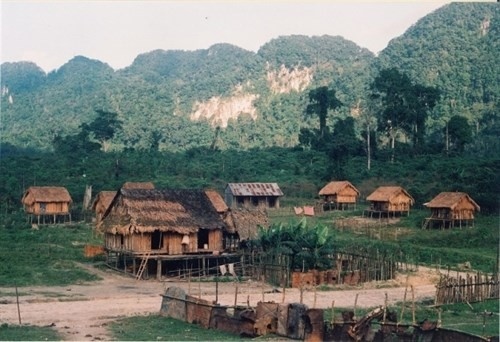
The Chut’s stilt houses are usually built on a steep, slope at the foot of a cliff, or near a spring. The stilt house has a simple structure that consists of wood joinery and rope lashing, with walls usually of bamboo and rattan.
The A Rem, Ma Lieng, and May live in stilt houses, while the Sach live in earthen houses. A Sach house May have 1, 2 or 3 compartments. When building a house, the Sach take into consideration the age of the house’s owner. The direction of the trees used to make the house is also specified with the root at the front and the top at the back along the length of the house; the root on the right and the top on the left side of the house; and the root below and the top above on the slope of the roof.
Dr. Kim Ngoc elaborates: “A Chut house has a sleeping and cooking area. The Sach live in ground-level houses in villages. The May and A Rem live in stilt houses. The Ma Lieng used to live temporary camps. Women slept in the cooking area. The main hall was only for men. A pillar at one corner with a protruding wood shelf serves as an ancestral altar. They don’t burn incense to worship.”
The Ruc were the last people to give up living in caves. After the resettlement campaign began in 1957, the number of people living in caves soon decreased. People moved to simple shacks and then to more permanent houses in Yen Hop and Mo O hamlet.
The post The nomadic life of the Chut in Vietnam appeared first on Vietexplorer.com.
View more from VietExplorer:
Discovering magnificent sunrise of Chuon lagoon in Thua Thien HueLocal photographers make Top 50 of AGORA Images’ #Travel2019
Stunning beauty of Quang Ngai captured from above
Discovering tranquility of Viet An lake in Quang Nam
Top places in Hanoi to enjoy Children’s Day celebrations
Exploring stunning sunrise of Phu Quy island
Local photographers into Top 50 of #Landscape2019 contest of AGORA Images
Top visitor-friendly destinations in northern region during October
Hanoi covered in festive decorations to celebrate Tet
First signs of spring beauty spotted on Hanoi streets
Spectacular displays by Finnish and British teams end Danang Fireworks Festival
Van Don Airport receives Vietnamese expats from COVID-19-hit areas
Beauty queens gather ahead of fashion show by designer Thanh Hoa
Beauty of Vietnam as seen through the lens of a French photographer
Amazing Vietnamese insects through the lens of Italian photographer
Ao Dai exhibition at Vietnamese Women’s Museum
Local photographers secure Top 50 spot in Agora Images’s #Women2019 contest
Mong ethnic people of the northwest celebrate Tet
Exploring beautiful Long Coc tea hills in Phu Tho amid sunrise
Stunning bombax ceiba flowers of Son La prove to be a hit among visitors
Comments
Post a Comment